
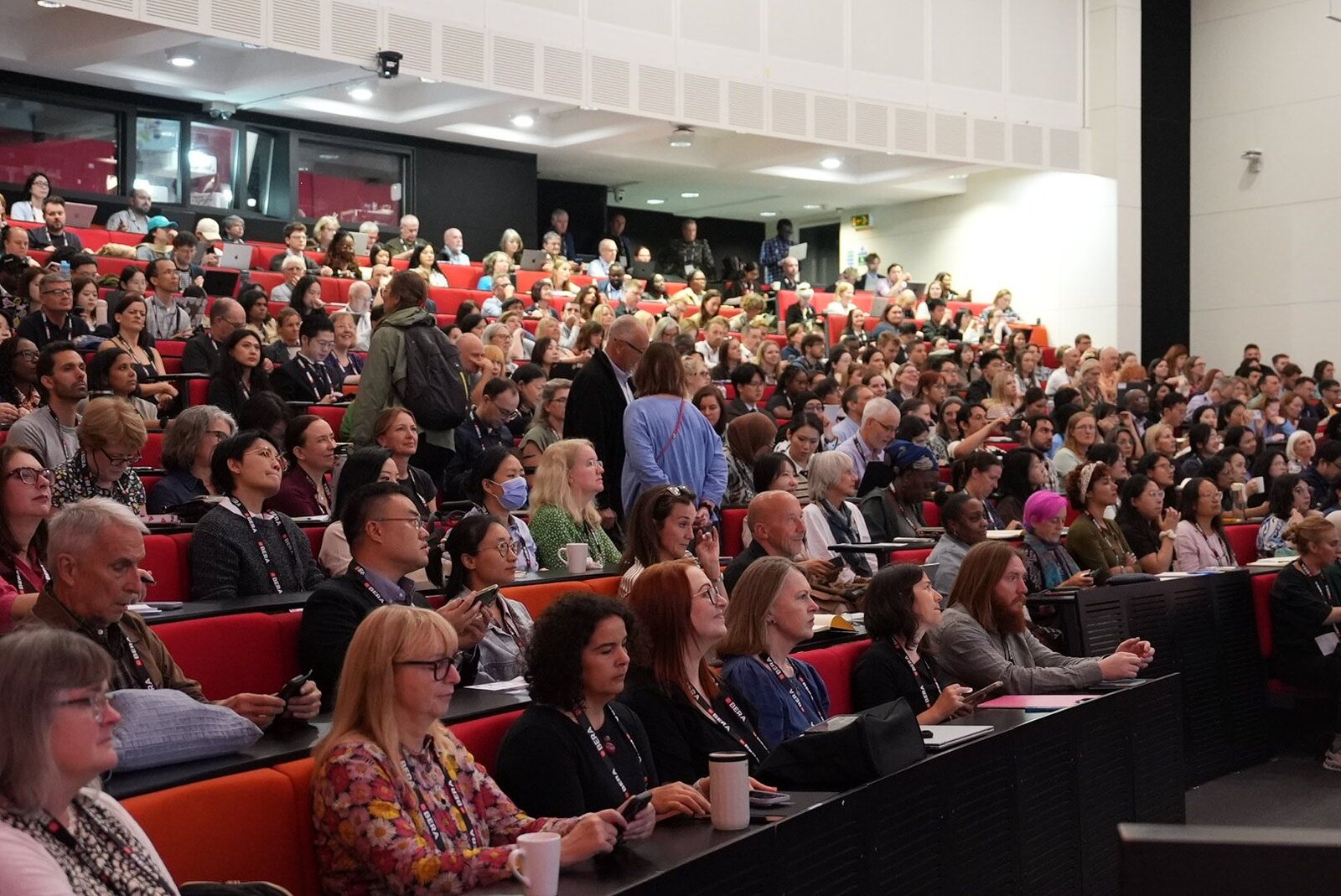
BERA 2026
Posted on 19th October 2026 by Elena Oncevska Ager & Matthew AgerElena and I took three things to BERA 2026: a symposium with Rob Caudwell, a paper, and a poster.
Symposium: Tact and AI
The response to generative AI in education has mostly been literacy: responsible use specified in advance and taught as a skill. We would argue that such frameworks arrive too early rather than too late, since learning begins where experience is interrupted (English, 2013) and a grammar written elsewhere removes the interruption before anything can be learned from it. Elena's pre-service teachers keep logbooks of classroom interruptions and tactless moments as they happen, and re-access them later with Noa, an AI carrying their teacher educators' encoded expertise. Rob described Mosaic by Penrose Education encoding its own values so as to grow with caution and without harming innovation. In each case tact develops through a permission to err and an openness to listen.
Paper: Mobilising Knowing-to
Mason and Spence (2000) add knowing-to act in the moment to Ryle's knowing-that, knowing-how and knowing-why. The first three can be mobilised instrumentally, and a language model has them; knowing-to is hard to capture and hard to mobilise, which is why mentoring is core to teacher development. Noticing captures recent incidents (logbook entries, classroom recordings, mentor conversations and AI mentoring histories), analyses them through a pipeline of skills each operationalising one theoretical lens, and displays them so that they can be re-vivified with a mentor or a community of practice. Two readings from separate traditions, disposition and discourse, correlate at r = 0.763 across 54 conversations.
Poster: Executable Pedagogy
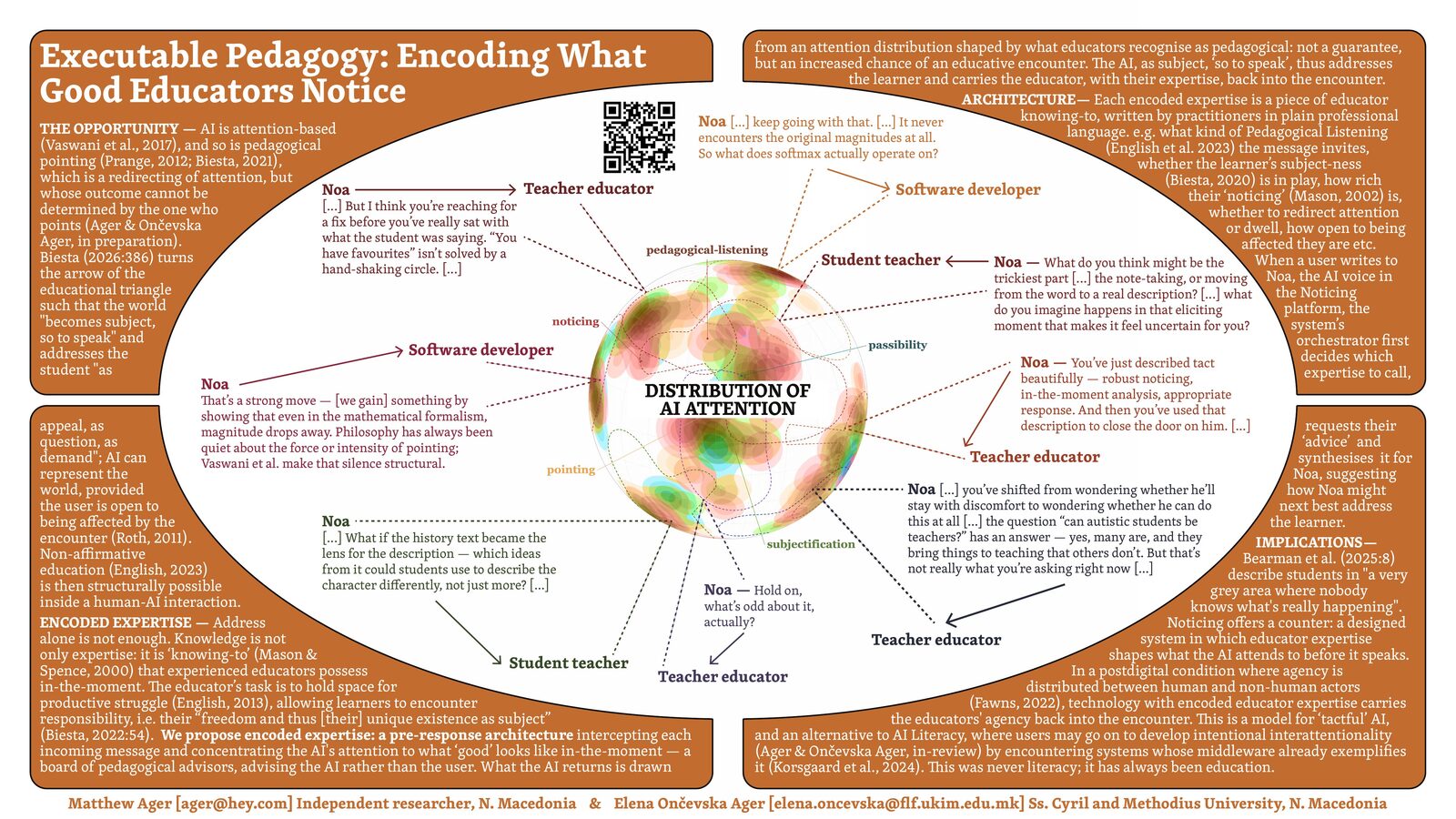
We have never left learners on their own; we built them a school, a safe place between the home and the world in which to practise being in the world. For an AI, an environment is a probability distribution, and it can be perturbed. Noticing intercepts each message to Noa with encoded expertise, educator knowing-to written by practitioners in plain professional language, so that a board of pedagogical advisors advises the AI rather than the user. The message sets where the AI's attention points, the expertise concentrates it around what educators recognise as pedagogical, and a distribution perturbed before every response is an environment in which learner and AI interact. We would argue that encoding what good educators notice is a design problem for educators rather than a literacy problem for learners.
I shared the symposium on LinkedIn. You might like to follow Noticing Network and Mosaic by Penrose Education.
Written by Elena Oncevska Ager
Written by Elena Oncevska Ager
Elena Oncevska Ager is Full Professor in Applied Linguistics at Ss Cyril and Methodius University
in Skopje, North Macedonia.
Her work involves teaching English for Academic Purposes (EAP) and supporting the development of English
language teachers, in face-to-face and online contexts. Her research interests revolve around EAP and
language teacher education, with a focus on mentoring, group dynamics, motivation, learner/teacher
autonomy and wellbeing.
Elena is particularly interested in facilitating reflective practice, in its many forms, including
through using the arts and by using AI to facilitate it. Her investigations are designed in such a way
as to inform her practice of supporting learning and teaching.
Written by Matthew Ager
Written by Matthew Ager
Matthew Ager is Software Architect and Co-Founder of Noticing.
Following his PhD in Applied Mathematics, and two years lecturing Mathematics and Physics, he has almost 15 years
experience in product design and development. His professional motivation stems from recognising and understanding
patterns in data, both quantitatively and qualitatively.
Matthew is naturally a reflective practitioner, with a keen ability to notice and articulate the subtleties of
his own behaviour and that of others. He is passionate about helping others to develop their own reflective
practice through technology, for greater wellbeing and professional development.