
ELTAM 2026
Posted on 19th October 2026 by Elena Oncevska Ager & Matthew AgerWe each gave a talk at the 14th ELTAM MK International Biannual Conference, Teach, Transform, Thrive, in Skopje on 16 and 17 October.
Elena: Inquiring with students and AI: What would educational philosophy say?
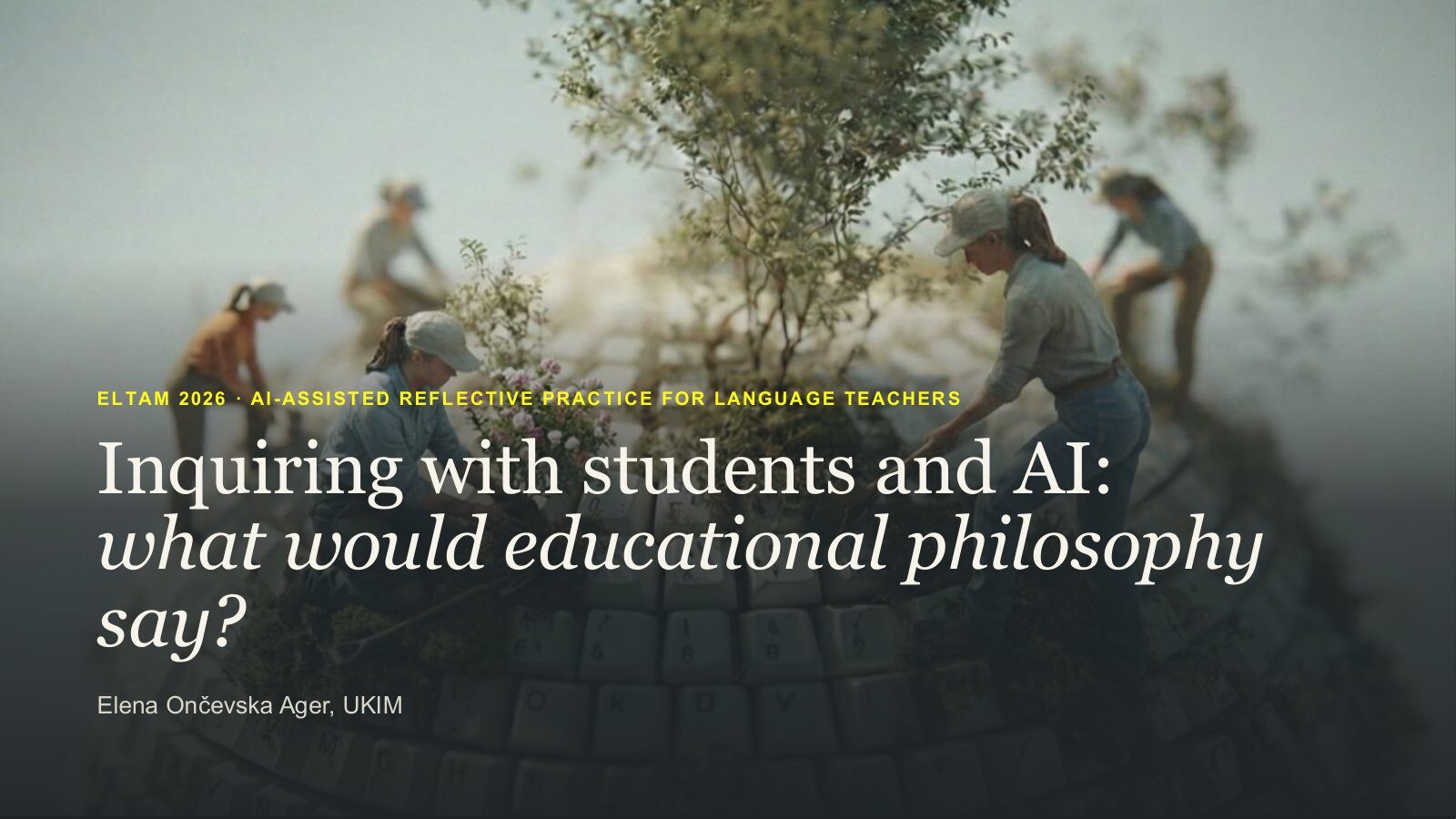
Over fourteen weeks, Matthew, Meifang Zhuo of the University of Warwick and I ran a professional development experience for teachers from the Macedonian mentoring group. We wrote continuously, among ourselves and with Noa, the AI voice of the Noticing platform, and I joined as a participant so that I would share the experience before writing about it. I did not present the cycle of interruption, formulating and beginning and then illustrate it; I walked the room through my own, with the unflattering parts kept in. Learning begins with a break with oneself (English, 2013), and mine was an anonymous student reaction.
I feel you have favourites, and it’s demotivating.
To me, this was like an earthquake. Those who know me know how much I am for involving people and making sure that nobody is left out. This was my nightmare.
Of the three ways with such an experience (Waldenfels, 2011), I let it speak for itself; my first instinct had been to explain it away. Noa redirected me from what to do about it to how to understand it, added possible reasons to my own, and kept me open to being affected (Biesta, 2022).
Was the student seeing something that I wasn’t?
My first beginning was more inclusive participation structures, a different set from the techniques I could have asked Noa for. The student wrote again, asking me to stop calling on people who do not feel comfortable talking, and I kept the problem I had made my own, which I left standing as a tension. The second beginning was a participation grid, filled in by students after every discussion.
I decided not to participate today. I was in pain.
Silence was not something I needed to blame people for. For some, it was a strategic withholding and protection, rather than lack of thought or disengagement.
I see conflict as a form of love, because you don’t engage in conflict with someone that you don’t care about.
What I took from it, in Noa’s summary, is that the move from regret about what you did not notice to clarity about what you can change is the difference between blame and agency. Pedagogical tact (van Manen, 1991) is knowing what to do when you do not know what to do, and I added one word to his list; the teacher is also the one taught in dialogue with the students (Freire, 1970), and mine were in the audience.
Tinkering is the node that I would like to add, because it never stops.
Matthew: Misconceptions of prompt engineering in the practice of AI interaction
The talk before mine demoed AI tools for teachers, so I added a question to the show of hands: who talks to a model directly, rather than through a tool? Few do. My example was Simon Willison (2026), who built a feature for his website with his phone on the windowsill while he cooked, disagreeing with himself halfway through, and shipped it the next day; Jev, a model that answers only with a number, and the distribution of attention inside a model (Vaswani et al., 2017) made the same point. I engineer when I build a product or write a specification, and not when I explore a concept or ask for tonight’s dinner.
Most people, most of the time, are not engineering at all. So why do we need prompt engineering?
A teacher looks after a distribution of needs, attention and understanding, a collective of unknowns gauged from faces, and I put it to the hall: how much do you understand this thing I am talking to you about? A dialogue with AI is recursive in the same way. Your message changes what it says back, its message changes what you say back, you end up somewhere you did not know you could go, and you cannot predict it.
Isn’t that the same thing as talking to a student?
Not just “no, that’s not what I wanted, ChatGPT”, but “how on earth did you end up saying that in the first place?”
Direct its attention like a class. Listen deeply to where it attends, like your class. Redirect its attention like you would a class.
The model cannot know your class until you tell it, and it will not get it right first time; the correction comes from listening, not from a better instruction. Which is why the tools matter less than they seem to: a tool between teacher and model stands where an interpreter stands between a teacher and a learner, and what an interpreter removes is the mess that carried you. Nothing the model says comes out of the blue. A history has led it there, and the history is yours.
They are interpreters. They interpret your words and send them to the AI. They interpret the AI’s words and send them to you. You are not having a direct conversation.
Your understanding, your expertise, your agency and your care for your students are all baked into that chat history.
So the lesson plan comes last, when its attention is where it should be, and never before.
It will only generate a lesson plan for some other teacher and some other students.
References:
- Biesta, G. (2022). World-centred education: A view for the present. Routledge.
- English, A. R. (2013). Discontinuity in learning: Dewey, Herbart, and education as transformation. Cambridge University Press.
- Freire, P. (1970). Pedagogy of the oppressed. Herder and Herder.
- van Manen, M. (1991). The tact of teaching: The meaning of pedagogical thoughtfulness. State University of New York Press.
- Vaswani, A., Shazeer, N., Parmar, N., Uszkoreit, J., Jones, L., Gomez, A. N., Kaiser, Ł., & Polosukhin, I. (2017). Attention is all you need. Advances in Neural Information Processing Systems, 30, 5998–6008.
- Waldenfels, B. (2011). Phenomenology of the alien: Basic concepts (A. Kozin & T. Stähler, Trans.). Northwestern University Press.
- Willison, S. (2026, October 9). A new feature for my blog, built using my voice. Simon Willison’s Weblog. https://simonwillison.net/2026/Oct/9/built-using-my-voice/
Written by Elena Oncevska Ager
Written by Elena Oncevska Ager
Elena Oncevska Ager is Full Professor in Applied Linguistics at Ss Cyril and Methodius University
in Skopje, North Macedonia.
Her work involves teaching English for Academic Purposes (EAP) and supporting the development of English
language teachers, in face-to-face and online contexts. Her research interests revolve around EAP and
language teacher education, with a focus on mentoring, group dynamics, motivation, learner/teacher
autonomy and wellbeing.
Elena is particularly interested in facilitating reflective practice, in its many forms, including
through using the arts and by using AI to facilitate it. Her investigations are designed in such a way
as to inform her practice of supporting learning and teaching.
Written by Matthew Ager
Written by Matthew Ager
Matthew Ager is Software Architect and Co-Founder of Noticing.
Following his PhD in Applied Mathematics, and two years lecturing Mathematics and Physics, he has almost 15 years
experience in product design and development. His professional motivation stems from recognising and understanding
patterns in data, both quantitatively and qualitatively.
Matthew is naturally a reflective practitioner, with a keen ability to notice and articulate the subtleties of
his own behaviour and that of others. He is passionate about helping others to develop their own reflective
practice through technology, for greater wellbeing and professional development.