
Postdigital Backlash 2026
Posted on 20th October 2026 by Matthew Ager & Elena Oncevska AgerWe took a paper to Postdigital Backlash: Past, Present, Future, in Zagreb on 22 and 23 June, a conference on the growing resistance to constant digital connectivity and the postdigital position that gets beyond being for or against it.
Paper: Not Failure but Beginning: Error-Exploration, Encoded Tact, and AI in Macedonian Teacher Education
Generic AI gives the impression that understanding can happen without thinking (Costa & Murphy, 2025), and AI literacy frameworks, for all their progressive appearance, remain affirmative in Benner's (2023) sense: they anticipate the result of the educative process and reduce competent use to error-avoidance. We argued the opposite, with Oser and Spychiger (2005): permission to err, not as failure but as beginning (English, 2023), and with it tact, the attentive in-the-moment disposition, cultivated inside the interaction with AI rather than taught in advance of it.
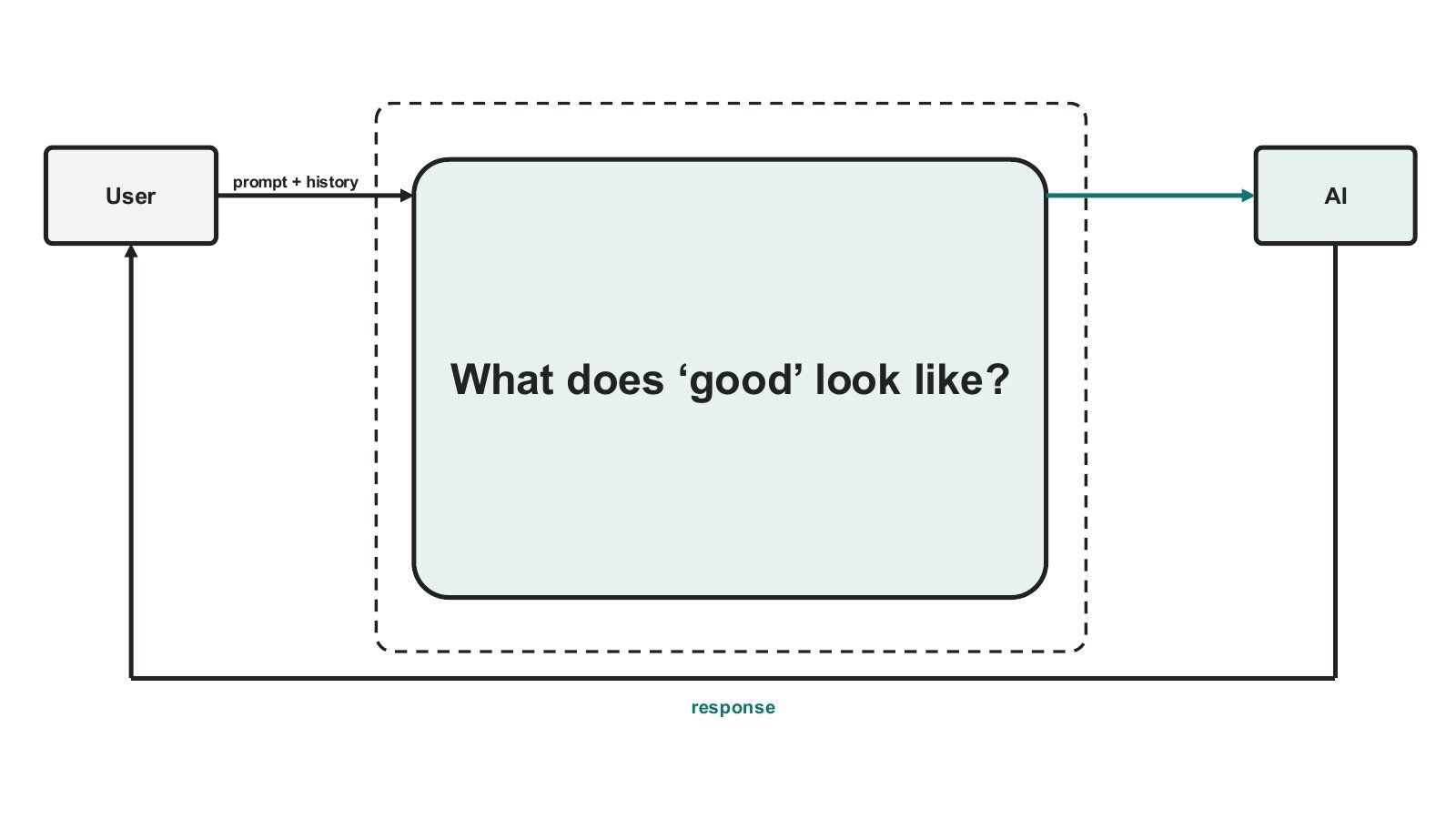
The paper traced three positions for the user. The user-as-teller sends a prompt and gets a response, and now gets “thinking” back as well. The user-as-listener attends to what comes back and to why, which is where the practice begins. The user-as-practitioner stands in Brinkmann's (2022) reciprocal and uncertain relation between drawing attention and becoming attentive, in which a moment of shared attention can occur. The question that organises the design is the one on the slide above: what does ‘good’ look like?
Our answer is Noticing's pre-response middleware. Each message to Noa is read first by a set of skills, each operationalising one lens (pedagogical listening, interruption-in-between, passibility, subjectification, pointing), and an orchestrator synthesises their advice into how to respond and how much to say. We showed it at work on two conversations. A teacher reflecting on her presence with students writes that it is odd that it should matter so much for adults learning to learn on their own; the middleware tells Noa to hold the space and return her own word, and Noa says five words. A child doing her maths homework with a parent answers “12” to how many teams of three six people make; the middleware tells Noa not to grade the answer but to ask how she got there, and Noa keeps asking until she draws a line between the six children in her book.
What is encoded is not AI with wisdom but AI carrying expertise: practitioners writing in natural language what good looks like, so that they refuse, in Benner's phrase, to affirm an alternative future envisioned by other actors. Rather than explaining the black box, a pedagogy for an AI-mediated world works with opaque, partial and ambiguous situations (Bearman & Ajjawi, 2023), and the middleware is a safe environment between the learner and the world, which is what a school has always been. When teachers listen to learners' uncertainty and struggle, English (2023) writes, learners learn to listen, not as obedience but as the desire to learn from their own uncertainty, and that is the subjectness that matters.
References:
- Bearman, M., & Ajjawi, R. (2023). Learning to work with the black box: Pedagogy for a world with artificial intelligence. British Journal of Educational Technology, 54(5), 1160–1173. https://doi.org/10.1111/bjet.13337
- Benner, D. (2023). On affirmativity and non-affirmativity in the context of theories of education and Bildung. In M. Uljens (Ed.), Non-affirmative theory of education and Bildung (pp. 21–59). Springer.
- Brinkmann, M. (2022). Attention, pointing and showing. In G. D'Agostino (Ed.), Phenomenologies of intersubjectivity. Scholé.
- Costa, C., & Murphy, M. (2025). Generative artificial intelligence in education: (What) are we thinking? Learning, Media and Technology, 1–12.
- English, A. R. (2023). Dewey, existential uncertainty and non-affirmative democratic education. In M. Uljens (Ed.), Non-affirmative theory of education and Bildung (pp. 139–158). Springer. https://doi.org/10.1007/978-3-031-30551-1_6
- Oser, F., & Spychiger, M. (2005). Lernen ist schmerzhaft: Zur Theorie des negativen Wissens und zur Praxis der Fehlerkultur. Beltz.
Written by Matthew Ager
Written by Matthew Ager
Matthew Ager is Software Architect and Co-Founder of Noticing.
Following his PhD in Applied Mathematics, and two years lecturing Mathematics and Physics, he has almost 15 years
experience in product design and development. His professional motivation stems from recognising and understanding
patterns in data, both quantitatively and qualitatively.
Matthew is naturally a reflective practitioner, with a keen ability to notice and articulate the subtleties of
his own behaviour and that of others. He is passionate about helping others to develop their own reflective
practice through technology, for greater wellbeing and professional development.
Written by Elena Oncevska Ager
Written by Elena Oncevska Ager
Elena Oncevska Ager is Full Professor in Applied Linguistics at Ss Cyril and Methodius University
in Skopje, North Macedonia.
Her work involves teaching English for Academic Purposes (EAP) and supporting the development of English
language teachers, in face-to-face and online contexts. Her research interests revolve around EAP and
language teacher education, with a focus on mentoring, group dynamics, motivation, learner/teacher
autonomy and wellbeing.
Elena is particularly interested in facilitating reflective practice, in its many forms, including
through using the arts and by using AI to facilitate it. Her investigations are designed in such a way
as to inform her practice of supporting learning and teaching.